One error that many Civil War
buffs, researchers, and historians commit is that they equate AWOL (which wasn't even coined until World War
I) with desertion.
One of the basic rules in studying history is to define the terms of the era. Although in today's
military the majority interchange "AWOL" (absent without leave or absence without leave) with "desertion," thus making
them one and the same, there has always technically been a difference. Whereas the
term Absent without Leave was first used in 1793 and its acronym AWOL can be traced to 1918, the Civil War was fought from
1861 to '65. Well into the 20th century Union and Confederate records were being transcribed by what was known as
a copyist, who often times indicated AWOL, which may explain the error.
As for historians and authors portraying the Civil War
soldier, who allegedly was caught while absent without leave, with an intrusive, large sign splashed with titanic
sized letters of "AWOL" hanging about the disgraced soldier's neck by a lanyard as he stumbled red-faced through
the camp for days -- it makes for graphic and colorful artwork, as well as an embellishment for marketing sake,
but any so-called account factually never happened.
Civil War desertion and deserters
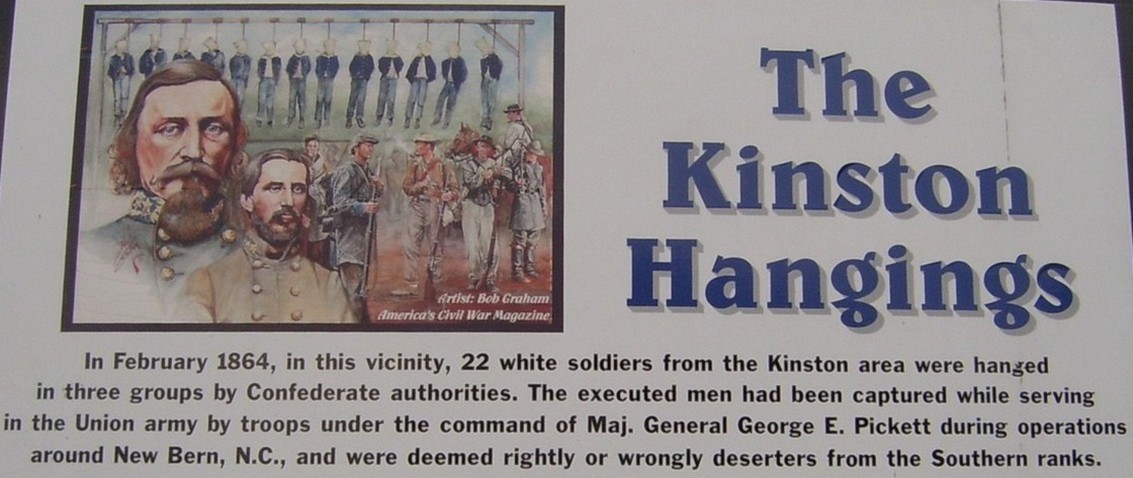
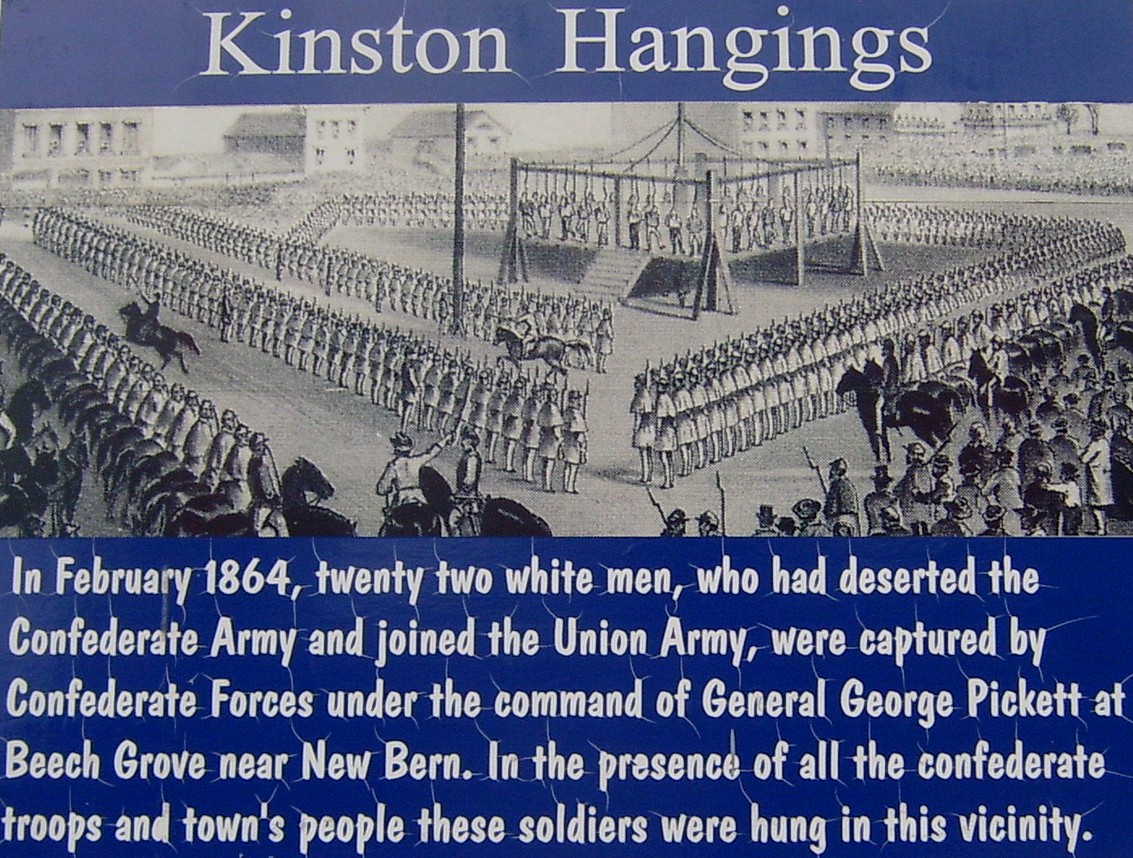
Rare Civil War mass execution on grounds of desertion.
(Above) The mass execution at Kinston, North Carolina,
was the exception and not the rule. While the hangings were based on confessions and eyewitness accounts, the controversy
arose by some stating that the accused were prisoners-of-war, while others affirmed that each of the 22 men were
Confederate deserters. The 22 men had been captured while wearing the Union uniform, but many, according to records,
also confessed to desertion and acknowledged the Confederate unit to which he had served. Few mass hangings of these numbers
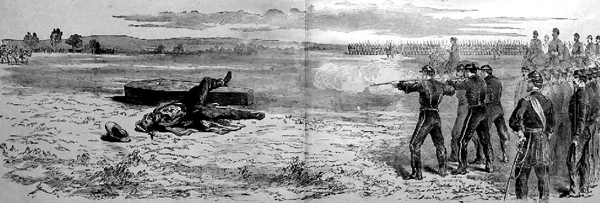
actually occurred as a result of desertion. The execution was performed by either hanging or firing squad, but when the
22 were found guilty of desertion in 1864, bullets were rather scarce, but there was always an abundance of rope in camp.
Civil War Desertion
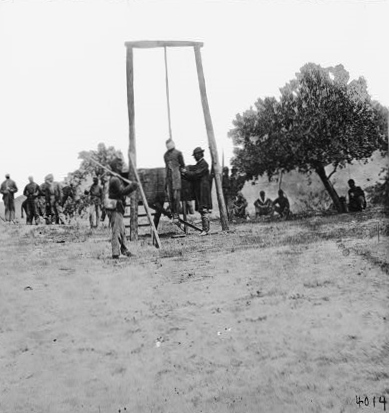
Civil War Deserter Hanged
(Right) Narrative:
Union soldier William Johnson was accused of "deserting the Union Army and attempting to rape a white woman." Johnson, on
the single "charge of attempted rape," was sentenced by the Union Army to death by hanging, and, on June 20, 1864, Johnson
was hanged in the vicinity of Petersburg, Virginia. Southern and Northern reporters alike, hoping to capitalize
on the hanging, posted various accounts of the hanging: "Execution of Negro William Johnson for the attempted rape of a Southern
lady. The Negro Johnson, ex-Union soldier, was hanged, June 20, 1864, in vicinity of Petersburg, Va." "A colored soldier,
face covered with cloth, hanging from scaffold. The executioner stands behind body, while white Union soldiers, some in uniform,
stand or sit nearby." "Execution of colored soldier on charge of attempted rape!" exclaimed yet another account.
Usage and Context
In
the Civil War the term absent simply meant that the soldier was not present at the unit’s specific muster
location and it was a broadly used term that was often applied until otherwise indicated, such as present, in hospital, or
deserted. In other words, the soldier may have been dead, temporarily absent or absent for a reason other than
leaving or deserting. Although Absent without Leave was defined as being absent without permission, it didn't necessarily
equate to desertion, a term usually applied with facts. Leave should not be confused with the period's oft used word furlough,
which traces its origin to ca. 1625.
In
the fog of war, for example, while many soldiers were carrying furlough papers, the regimental records, on the other
hand, were hastily written indicating that the soldiers were merely "absent." But there were also
soldiers who were declared absent or even absent without leave, only to be discovered dead on the battlefield or
in an enemy prison. Reasons for the soldier being absent ranged from recruiting duty, foraging orders, detached
duty (assignment), sickness or illness, prisoner-of-war, wounded or dead on the battlefield, rounding up deserters,
in the hospital, to visiting headquarters.
When the soldier deserted or abandoned his unit, the records were specific and indicated “deserted”
and not absent or absent without leave, and if the soldier was
absent or unaccounted for beyond an allotted time, then he was likely pronounced a deserter, too. There were,
however, many soldiers who were initially declared as absent without leave, only later to be found guilty
of desertion. So it is important to understand the difference between absent, absent without leave, and desertion.
Furlough, Leave, AWOL, and Desertion
Similar to today's military phrase "on leave," the Civil
War soldier who was authorized to return home for an allotted period was considered on furlough. During
the period, furlough was, however, an absence from duty, granted by a superior officer. The furloughed soldier carried
papers which described his appearance, his unit, when he left and when he was due to return. Furlough papers also contained
a warning that failure to return on the specific date would cause the soldier to be considered a deserter. Beyond the
furloughed timeframe, deserter or desertion were the terms officially applied, and
not the term absent without leave.
Union and Confederate Desertion and Deserters
While Civil War deserters rarely faced execution, the sentence was always by hanging or firing squad
Deserter, Missing Movement, and Failure to Appear
Although
the jargon Absent without Leave has evolved over the decades, in today's military it is technically different
than desertion. While the Air Force and Army generally refer to an unauthorized absence as being Absence without Leave, the Marine Corps, Navy, and Coast Guard refer to this as Unauthorized
Absence, or "UA." Desertion is considered a punitive offense under Article 58, Uniform Code of Military Justice, and any person
found guilty of desertion or attempting to desert in time of war is subject to the death sentence. Additional military
idioms now include Missing
Movement and Failure to Appear. Missing Movement is applicable when a member of the armed forces fails to arrive
at the appointed time to deploy (or "move out") with their assigned unit, ship, or aircraft. (Article 87, UCMJ) The offense
is similar to absence without leave and is also a punitive offense. Failure to Appear consists of missing
a formation or failing to appear at an assigned place and time when so ordered. The offense is punishable under
section 1, Article 86, UCMJ.
*Union
and Confederate records usually specified absent and the reason (foraging, for example), or absent without leave. Through
the decades the phrases "away without leave" and "absent without official leave" have also been applied. Although officially
now known as "Absence without Leave" according to Article 86, Uniform Code of Military Justice, the earliest use
of the acronym AWOL actually dates to WWI.
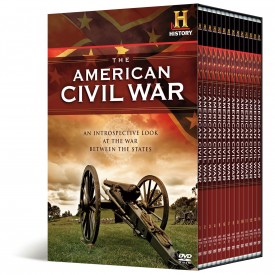
Recommended Viewing: The American Civil War (DVD Megaset)
(2009) (A&E Television Networks-The History Channel) (14 DVDs) (1697 minutes) (28 Hours 17 Minutes + extras). Experience
for yourself the historical and personal impact of the Civil War in a way that only HISTORY can present in this moving megaset™,
filled with over 28 hours of American Civil War content. This MEGASET is the most
comprehensive American Civil War compilation to date and is the mother of all Civil War documentaries.
A multifaceted look at “The War Between the States,” this definitive collection brings the most legendary Civil
War battles, and the soldiers and leaders who fought them, vividly to life. From Gettysburg and Antietam to Shiloh, and led
by the likes of Sherman, McClellan, Grant, Beauregard, Lee, Davis, and Jackson, delve into the full military and political
contexts of these men, their armies, and the clashes between them. Continued below...
Almost 150 years after Lee’s surrender at Appomattox Court House,
the unexpected secrets and little-known stories from Civil War history are divulged with fascinating detail. Cutting-edge
CGI and accurate dramatizations illustrate archival letters and original diary entries, and the country’s most renowned
historians describe the less familiar incidents that add perspective and depth to the war that divided a nation. If the DVDs
in this Megaset were purchased separately, it could cost hundreds of dollars. This one-of-a-kind compilation belongs on the
shelf of every Civil War buff, and if you know anyone that is interested in the most costliest and bloodiest war in American
history, buy this, they will love it.
THE AMERICAN CIVIL WAR contains the following programs:
* The Most Daring Mission Of The Civil War * April 1865 * Battlefield
Detectives: The Civil War (3 Episodes): Antietam, Gettysburg, Shiloh * Secret Missions Of The Civil War * The Lost Battle
Of The Civil War * Tales Of The Gun: Guns Of The Civil War * Eighty Acres Of Hell * Lincoln * Investigating History:
Lincoln: Man Or Myth * Man, Moment, Machine: Lincoln & The Flying, Spying Machine * Conspiracy?: Lincoln Assassination *
High Tech Lincoln * Sherman’s March * The Hunt For John Wilkes Booth * Civil War Combat (4 Episodes): The Hornets’
Nest At Shiloh, The Bloody Lane At Antietam, The Wheatfield At Gettysburg, The Tragedy At Cold Harbor * Civil War Journal
(8 Episodes): John Brown's War, Destiny At Fort Sumter, The Battle of 1st Bull Run, The 54th Massachusetts, West Point Classmates—Civil
War Enemies, Robert E. Lee, Stonewall Jackson, Sherman And The March To The Sea
BONUS FEATURES:
* Full-Length Documentary “Save Our History: Sherman’s Total
War Tactics” * Behind the Scenes Featurettes for “Sherman’s March” and “Lincoln”
Recommended Viewing: The Civil War - A Film by Ken Burns. Review:The
Civil War - A Film by Ken Burns is the most successful public-television miniseries in American history. The 11-hourCivil War didn't just captivate a nation,
reteaching to us our history in narrative terms; it actually also invented a new film language taken from its creator. When
people describe documentaries using the "Ken Burns approach," its style is understood: voice-over narrators reading letters
and documents dramatically and stating the writer's name at their conclusion, fresh live footage of places juxtaposed with
still images (photographs, paintings, maps, prints), anecdotal interviews, and romantic musical scores taken from the era
he depicts. Continued below...
The Civil War uses all of these devices to evoke atmosphere and resurrect an event that many knew
only from stale history books. While Burns is a historian, a researcher, and a documentarian, he's above all a gifted storyteller,
and it's his narrative powers that give this chronicle its beauty, overwhelming emotion, and devastating horror. Using the
words of old letters, eloquently read by a variety of celebrities, the stories of historians like Shelby Foote and rare, stained
photos, Burns allows us not only to relearn and finally understand our history, but also to feel and experience it. "Hailed
as a film masterpiece and landmark in historical storytelling." "[S]hould be a requirement for every
student."
Editor's Picks and Recommended
Reading for American Civil War Desertions and Deserters