|
North Carolina in the Civil War
North Carolina and the American Civil War
North Carolina and the American Civil War
"When one totals the North Carolinians that died in World War I, World War II, Korea
and Vietnam, it is far less than North Carolina's
American Civil War death toll."
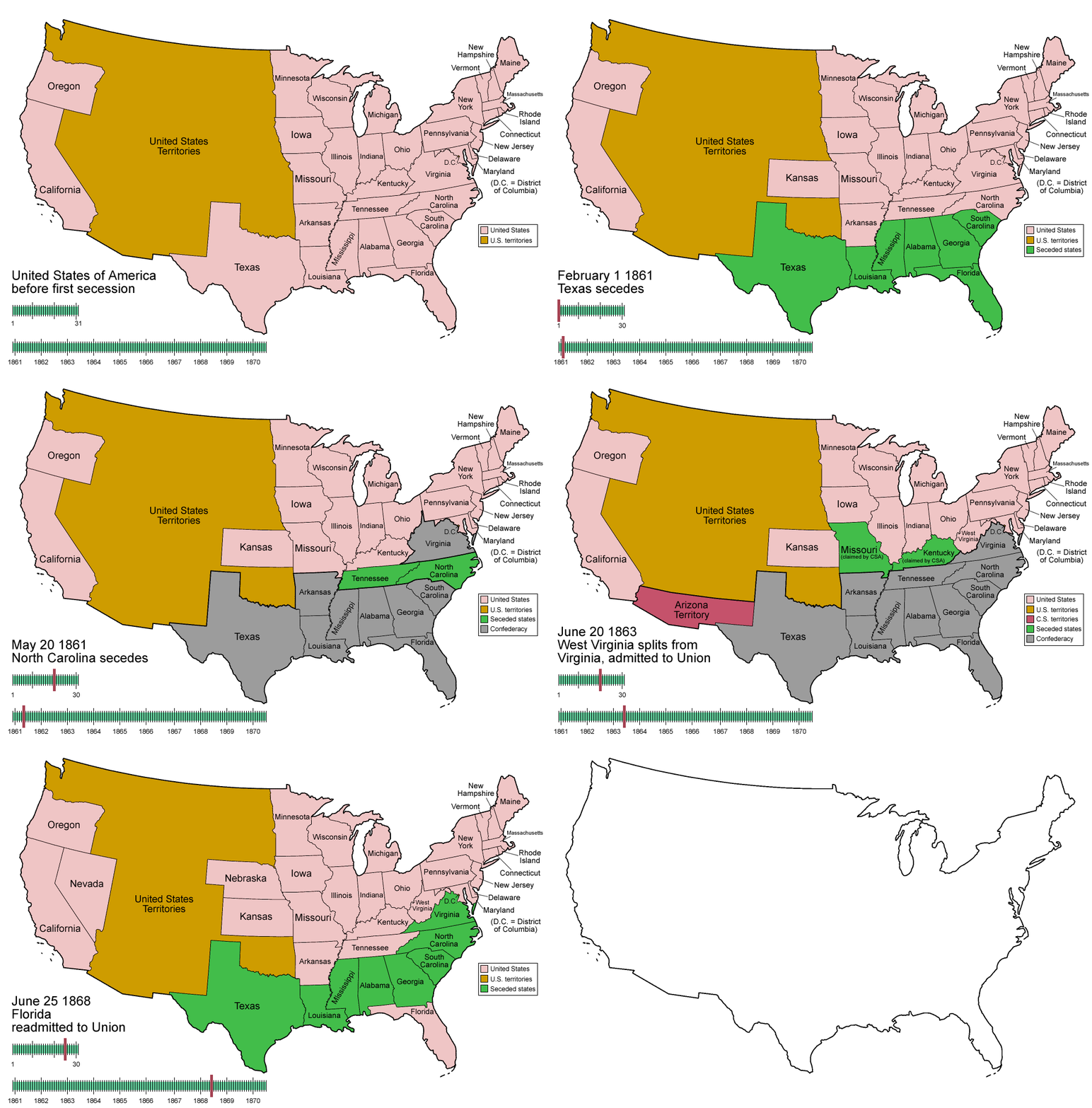
| North Carolina Civil War Map |
|
| North Carolina Civil War History |
"In the agitation that pervaded the South previous to secession, North
Carolina preserved its usual conservative calmness of action."
The people of North Carolina, although profoundly stirred and keenly alive
to the gravity of the impending crisis, were loath to leave the Union cemented by the blood of their fathers. That retrospectiveness
which has always been one of their marked characteristics, did not desert them then. Even after seven of her sister States
had adopted ordinances of secession, "her people solemnly declared" -- by the election of the 28th of February, 1861,
-- "that they desired no convention even to consider the propriety of secession."
But after the newly-elected President's
Springfield speech, after the widespread belief that the Federal government had attempted to reinforce
Fort Sumter in the face of a promise to evacuate it, and especially after President Lincoln's requisition on the governor
to furnish troops (Governor John Willis Ellis: A Reply to President Lincoln) for what Governor Magoffin, of Kentucky, called "the wicked purpose of subduing sister Southern States," -- a requisition that, Governor Jackson, of Missouri, in a superflux
of unlethargic adjectives, denounced as "illegal, unconstitutional, revolutionary, inhuman, diabolical" -- there was
a rapid change in the feelings of the people of North Carolina. Strong union sentiment was changed to a fixed determination
to resist coercion by arms if necessary. So rapid was the movement of public events, and so rapid was the revolution in public
sentiment, that "just three months after the State had refused even to consider the question
of secession, a convention composed of almost entirely of men who thought
it was the imperative duty of their State to withdraw from the Union was in secession in Raleigh." (Southern States Secede: Secession of the South History.)
On May 20th, a day sacred to
her citizens in that it marked the eighty-six anniversary of the colonial Declaration of Independence of England, the
fateful ordinance that severed relations with the Union was adopted:
AN ORDINANCE TO DISSOLVE THE UNION BETWEEN THE STATE OF NORTH CAROLINA AND THE OTHER
STATES UNITED WITH HER UNDER THE COMPACT OF GOVERNMENT ENTITLED THE CONSTITUTION OF THE UNITED STATES.
We, the people of the State of North Carolina, in Convention assembled, do declare
and ordain, and it is hereby declared and ordained, That the ordinance adopted by the State of North Carolina in the Convention
of 1789, whereby the Constitution of the United States was ratified and adopted, and also, all acts and parts of acts of the General Assembly, ratifying and adopting amendments
to the said Constitution, are hereby repealed, rescinded and abrogated.
We do further declare and ordain, That
the union now subsisting between the State of North Carolina and the other States under the title of the United States of
America, is hereby dissolved, and that the State of North Carolina is in the full possession and exercise of all those rights
of sovereignty which belong and appertain to a free and independent State. [Ratified the 20th day of May, 1861.]
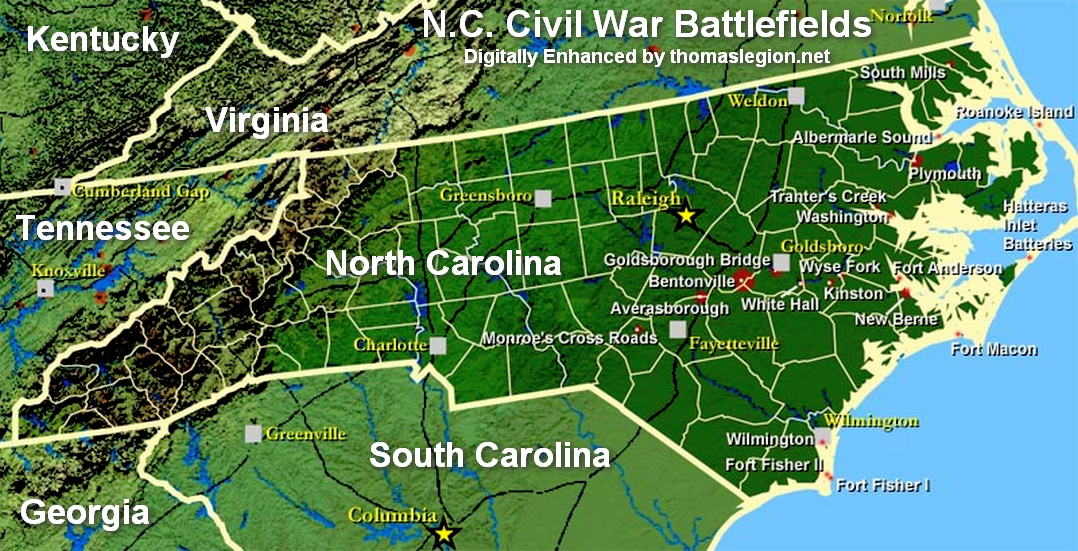
| North Carolina and the Civil War |
|
| North Carolina Civil War Battles |
North Carolina in the American Civil War Overview
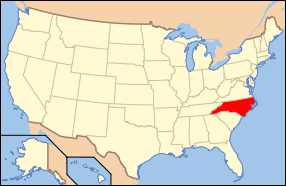
| North Carolina (Shaded in Red) |
|
| North Carolina Map |
In 1860,
on the eve of the American Civil War, North Carolina was a rural state with a total population of 992,622. Most citizens had
been born in North Carolina and farmed for a living. Foreign-born people made up less than 1 percent of the state's population
in 1860, and 72 percent of white families owned no slaves. African Americans, however, accounted for approximately
one-third of the total population, and the majority were slaves.
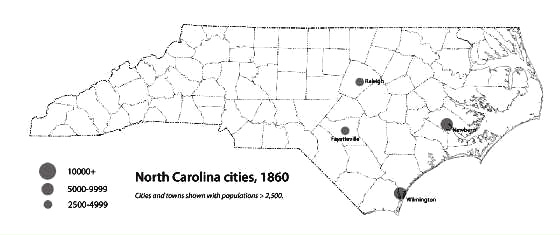
Few urban commercial centers
existed, and the largest town, Wilmington in New Hanover County, had nearly 10,000 residents.
| North Carolina Civil War Population Map |
|
| (During the Civil War, Wilmington was North Carolina's largest city) |
During the antebellum period, North Carolina was an overwhelmingly
rural state, even by Southern standards. In 1860 only one North Carolina town, the port city of Wilmington, had a population
of nearly 10,000. Raleigh, the state capital, had barely more than 5,000 residents.
In 1860 there were 69,000 farms in North Carolina. 46,000
of these, or 71%, were less than 100 acres in size. In 1860 there were only 300 plantations of 1,000 acres or more
in the state, and the census listed 121 planters and 85,198 farmers. North Carolina has a long history of small farm size.
Cattle and hogs were on free range, and livestock was fenced out of fields. Cutting trees for fence rails was a major
cause of forest destruction. The production of turpentine, primarily for use in shipping, was the largest manufacturing industry
in North Carolina. Two-thirds of the nation’s output of turpentine was from North Carolina. Most turpentine
distilleries were located in Bladen, Cumberland, and New Hanover Counties.
In 1860, North Carolina had 39 cotton mills and 9 woolen mills in operation. Industry grew in the state; however, North Carolina remained essentially rural. Wilmington,
the state’s largest and most cosmopolitan city had only 9,542 inhabitants. The number of common schools was 2,854, with a statewide enrollment of 118,000 white students. Illiteracy among whites
had dropped from 30 percent in 1840 to 23 percent in 1860. (North Carolina Civil War History and North Carolina in the Civil War: Interactive.)
From Florida to Maine, from east to west, North Carolina has the greatest length or width
of any state on the east coast. Covering a long and vast distance of 560 miles made defending the North Carolina borders during the Civil War, from the Atlantic Ocean and adjoining rivers to its
rugged mountains and highest peak, no easy task.
The majority of North Carolinians
in 1860 came from white yeoman families who worked small farms, fifty to one hundred acres in size, and owned no slaves. They
had more concern about rainfall, crops, and seasonal changes for planting and harvesting than about national politics. They
produced much of what they consumed and relied on the sale of surplus crops for money to buy what they could not grow or make
by hand on their farms. Men from these families would constitute the majority of North Carolina's Confederate soldiers in
the coming war.
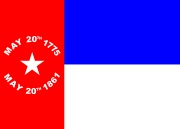
| 1861 North Carolina Flag |
|
| (1861 NC Flag) |
During the American
Civil War, houses were stripped of draperies and carpets to provide clothing and shelter for North Carolina's troops.
Even donated church bells were melted down and recast as cannon. Parched corn was substituted for coffee, and spinning wheels
once more competed with power looms. Yet opportunistic merchants and unscrupulous blockade runners continued to sell their
goods at the highest prices the market would bear.
Bacon soared from $.33 to $7.50 per pound, wheat went from
$3 to $50 a bushel, and coffee was selling at $100 per pound. While at least 125,000 Tar Heels served in service of the Confederate
States of America, almost eight times that number remained at home. Confronted with scarcities, exorbitant prices, and
depreciating currency, farm wives and plantation mistresses, old men and small children, free blacks and domestic servants
strove to make ends meet.
North Carolina and the War Between the States
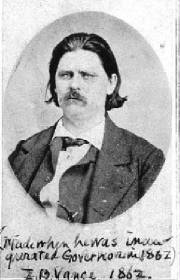
| NC Governor Zebulon Vance |
|
| "The War Governor" |
On April
13, 1861, Fort Sumter fell to South Carolina troops. President Lincoln, consequently, called
for 75,000 troops to coerce and subdue the seceded states (Lincoln's Call For Troops). On April 15 the Lincoln administration demanded that North Carolina furnish two regiments for this undertaking.
On
April 15, North Carolina Governor John Ellis promptly replied by telegram to President Abraham Lincoln and stated that "Your dispatch is received,
and if genuine, which its extraordinary character leads me to doubt, I have to say in reply, that I regard the levy
of troops made by the administration for the purpose of subjugating the states of the South, as a violation of the Constitution,
and as a gross usurption of power. I can be no party to this wicked violation of the laws of the country and to this war upon
the liberties of a free people. You can get no troops from North Carolina."
Zebulon Vance (right) arrived in Washington at the age 28 and was the youngest member of Congress
and one of the strongest Southern supporters of the Union. In March of 1861, however, when indications reflected that the
North Carolina legislature was going to vote for secession, Vance resigned his seat and returned home. Vance was soon elected as North Carolina's governor in 1862 and reelected
in 1864. (North Carolina Governors.)
The
young Vance was known throughout the Southern states as the "War Governor of the South," not because he was a war hawk, but
because of his ability to wisely manage the state even during its most tumultuous hour. Many believed that the most remarkable
Vance policy was his insistence of the rule of law in the midst of the devastation and confusion of Civil War. Vance had previously
commanded the valiant 26th North Carolina Infantry.
Early
in the war, "General Robert E. Lee was fearful that General Ambrose Burnside would find out the defenseless condition of North
Carolina and move forward. Every night General Lee telegraphed: 'Any movement of the enemy in your front to-day?'"
At
the close of 1862, only two regiments of infantry were left in North Carolina, the Fiftieth and Fifty-first, and the Union
forces on the coast could, had they been apprised of the heavy movement of troops, "have swept without opposition over all
the State. A people less brave and less patriotic would never have consented to incur such a risk with so strong an enemy
at its doors. The governor exposed his own capital to save that of the Confederacy." At the close of the Civil War, consequently, North Carolina had
"forty regiments in Virginia."
North Carolina Numbers and American Civil War Military Contributions
The total white population of
the eleven seceding states was 5,441,320 – North Carolina’s
was 629,942, and it was third in white population. North Carolina,
however, provided more troops to the Confederacy than any other Southern state.
On November 19, 1864, Adjutant-General
R. C. Gatlin, a most careful and systematic officer, made an official report to the governor on this subject. The following
figures, compiled from that report by Mr. John Neathery, give the specific information:
--Number of troops transferred
to the Confederate service, according to original rolls on file in this office: 64,636
--Number of conscripts between
ages of 18 and 45, as per report of Commandant of Conscripts, dated September 30, 1864: 18,585
--Number of recruits that have
volunteered in the different companies since date of original rolls (compiled): 21,608
--Number of troops in unattached
companies and serving in regiments from other states: 3,103
--Number of regular troops in
State service: 3,203
Total offensive troops: 111,135
--To these must be added: Junior
reserves: 4,217
--Senior reserves: 5,686
Total troops in active service:
121,038
--Then, organized and subject
to emergency service in the State, Home Guard, and Militia: 3,962
Total troops, armed, equipped
and mustered into State or Confederate service: 125,000
Remarkable proof of the State’s
brave devotion to the Confederacy is noteworthy in this connection. As shown by the 1860 census, the total number of men in
North Carolina between the ages of 20 and 60, the extreme
limits of military service, was 128,889. Subtract the 125,000 troops furnished, and it reveals the extraordinary fact that
there were only 3,889 men subject to military duty who were not in some form of military service. Most of these 3,889 were
exempted because they were serving the State in the following civil capacities: magistrates, county officers, dispensers of
public food, etc. So, practically, every man in the State was serving the State or the Confederacy.
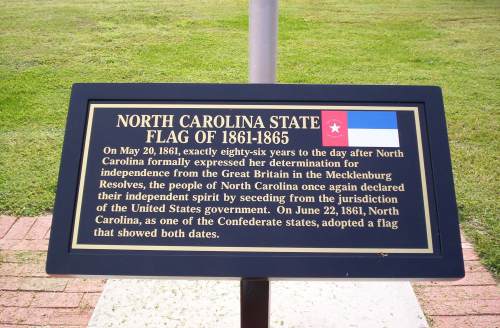
| North Carolina State Flag and the Civil War |
|
| (North Carolina and the Confederate Flag) |
During the American Civil War, North Carolina provided at least 125,000 soldiers to the Confederacy, and the Tar Heel State recruited more soldiers than any Southern state. More than 620,000 died in the Civil War and approximately 40,000 were North Carolinians. (Total Union and Confederate Civil War Killed and Mortally Wounded (Dead), With Numbers for Each Northern
and Southern State: North Carolina Emphasis.)
The Old North State provided 69 infantry regiments and 4 infantry battalions; 9 cavalry
regiments and 9 cavalry battalions; 2 heavy artillery battalions, 4 artillery regiments, 3 light artillery
battalions, and 4 light artillery batteries. Several North Carolina infantry regiments mustered 1,500 soldiers,
while few regiments mustered as many as 1,800. Furthermore, North Carolina's sole legion, Thomas' Legion, mustered more than 2,500 soldiers, while the average Civil War regiment mustered 1,100 soldiers. Regarding the State's troops, A Guide to Military Organizations and Installations
of North Carolina 1861-1865, explains the numerical designations according to branch of service and
the nature and character of each unit's organization.
Approximately 10,000 white
North Carolinians served the United States during the war, while more than 5,000 North Carolina African Americans joined the Union Army. These free
blacks and escaped slaves served in segregated regiments led by white officers. Continued below...
Recommended Reading: Confederate Military History Of North Carolina: North Carolina In The Civil War, 1861-1865.
Description: The author, Prof. D. H. Hill, Jr., was the son of Civil War Lieutenant
General Daniel Harvey Hill (North Carolina produced only
two lieutenant generals and it was the second highest rank in the army) and his mother was General “Stonewall”
Jackson’s wife's sister. In Confederate Military History Of North Carolina,
Hill discusses North Carolina’s massive task of preparing and mobilizing for the conflict; the many regiments and battalions
recruited from the Old North State; as well as the state's numerous contributions during the war. Continued below...
During Hill's Tar Heel State
study, the reader begins with interesting and thought-provoking statistical data regarding the 125,000 "Old North State"
soldiers that fought during the course of the war and the 40,000 that perished. Hill advances with the Tar Heels to the first
battle at Bethel, through numerous bloody campaigns and battles--including North
Carolina’s contributions at the "High Watermark" at Gettysburg--and concludes
with Lee's surrender at Appomattox.
Confederate Army and
Civil War Battles and Battlefields
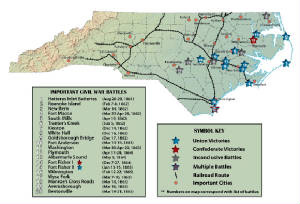
| NC Civil War Battle Map |
|
| North Carolina Civil War Battlefield Map |
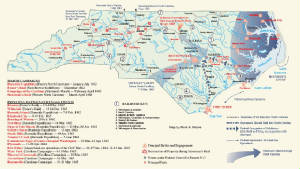
| North Carolina Civil War Battle Map |
|
| NC Civil War Battlefield Map |
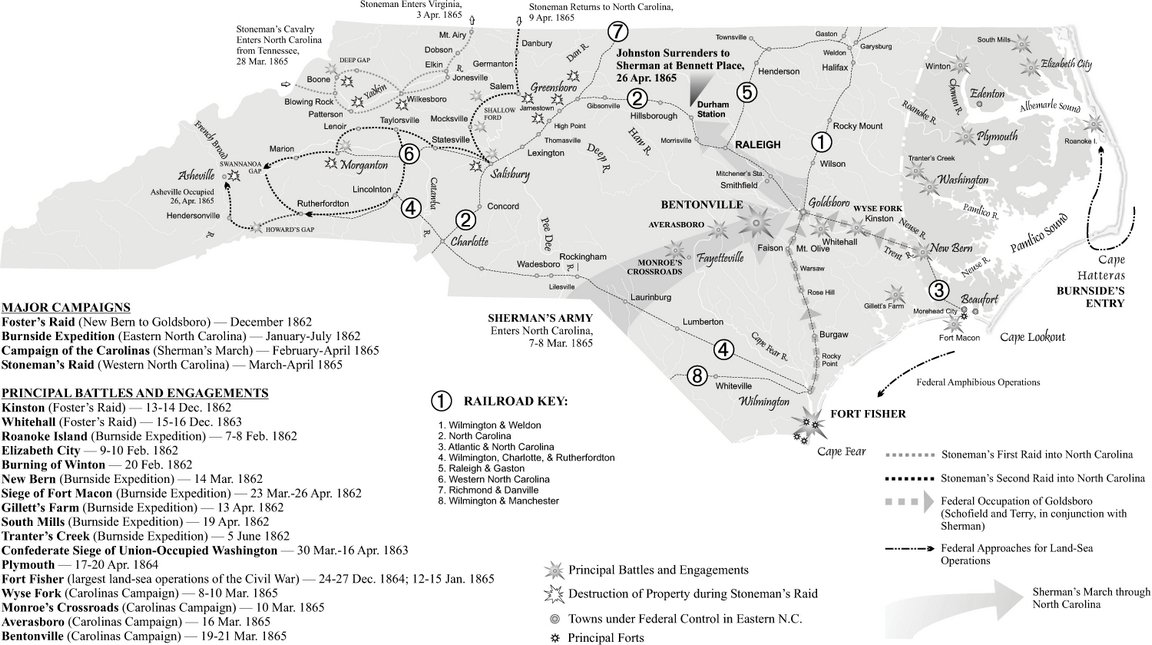
(About) Map showing principal battles and campaigns contested in North Carolina.
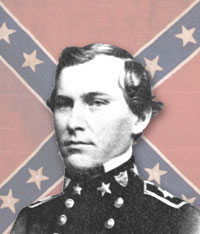
| Brig. Gen. Lawrence O'Brian Branch |
|
| (NPS) |
For the
North Carolina troops that so freely offered themselves there were no arms, except for those that the State had seized in
the Fayetteville arsenal. These, according to President Jefferson Davis, consisted of merely 2,000 Enfield rifles and 25,000
old style, smooth-bore guns that had been changed from flint-and-steel to percussion. After these had been issued, the
organizing regiments found it impossible for some time to get proper arms.
The Thirty-first
North Carolina, for example, went to the front with sporting rifles and fowling-pieces, while others, such as the Second battalion,
supplemented their arms by borrowing, from the governor of Virginia, 350 veritable flint-and-steel guns that nobody else would
have. Some of North Carolina’s units organized and drilled until the battles of Manassas (Bull Run) and Seven Pines,
and were then supplied with the excellent captured rifles of the enemy. However, after the fall of 1862 there was no difficulty
in getting fairly effective small arms.
As
the first winter of war drew on, however, a serious question that confronted the State authorities was how to clothe
and shoe the forty regiments in the field; for it was evident the Confederacy could not do it.
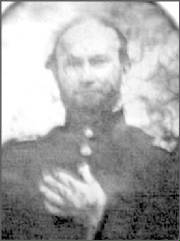
The legislature directed General James Green Martin (right),
late in September, to provide winter clothing, shoes, etc., for the troops. The time was short and it was no small task, but
he went about it with his usual energy. He organized a clothing factory in Raleigh,
under the leadership of Captain Garrett; every mill in the State was made to furnish every yard of cloth that was possible;
Captain A. Myers was sent through North Carolina, South Carolina and as far south as Savannah, Georgia, purchasing everything
that was available for clothing the troops. The ladies came nobly to their assistance and furnished blankets, quilts, and
whatever they could. Many carpets were torn up, and by the combined efforts of the ladies and the officers, these were lined
with cotton and made into quilts. The troops of North Carolina were clothed the first winter of the war, if not exactly according
to military regulations, at least in such a manner as to prevent much suffering. After this winter the State was in better
condition to supply the wants of the troops.
| Brig. Gen. James Green Martin |
|
| Tintype photograph courtesy LOC |
Regarding the preparing, organizing, and mobilizing of North Carolina for the Civil War: "The
man [James Green Martin] thus trusted was a one-armed veteran of the Mexican war, a rigid disciplinarian, thoroughly
trained in office work, and not only systematic but original in his plans. The State has never fully appreciated, perhaps
never known, the importance of the work done for it by this undemonstrative, thoroughly efficient officer." Words of
Daniel Harvey Hill, Jr., author of Confederate Military History Of North Carolina: North Carolina
In The Civil War, 1861-1865
The United States Arsenal at Fayetteville was also enlarged and machinery that had been removed from the captured
United States armory in Harpers Ferry, Virginia (now West Virginia), was
installed there. This manufacturing complex became the second-largest source (after Richmond)
of domestically produced arms in the Confederacy. In addition, there were rifle-manufacturing sites in Asheville
and Guilford County.
A large bayonet factory was established in Raleigh, and in
Kenansville a private concern made swords, bayonets, and other war-related goods. North
Carolina's entire textile production during the war was used for uniforms and other military supplies.
| North Carolina Civil War Battle & Battlefield Map |
|
| Civil War battles fought in North Carolina Map |
During campaigns, huge numbers of men and large quantities of equipment
shifted and maneuvered across the landscape. Most North Carolina soldiers carried a haversack, an oilskin cloth, a blanket,
a rifle, a bayonet, cartridges, percussion caps, a cartridge box, a drinking cup, and
a canteen. Troops often marched twelve to fifteen miles a day. Seasoned soldiers soon learned to carry only essential items.
The following Major Civil War Campaigns, Expeditions, Operations, and Raids were
fought on North Carolina soil:
| Lt. Gen. D. H. Hill |
|
| Library of Congress |
At the close of 1862,
only two regiments of infantry were left in North Carolina, the Fiftieth and Fifty-first, and the Union forces on the coast
could, had they been apprised of the heavy movement of troops, "have swept
without opposition over all the State." (North Carolina Coast and the American Civil War.)
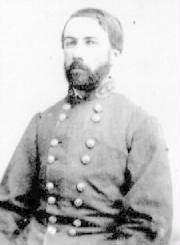
(Left) Photograph of North Carolina native Daniel Harvey
Hill. Commonly referred to as D. H. Hill, he was one of only two lieutenant generals from the Tar Heel State. Lieutenant
general was the second highest rank in the Confederate Army.
27%
of North Carolina's generals were killed-in-action; the generals truly led by example and they epitomized
the adage and embodied the motto: "I shall never request my men do what I, myself, would not."
| Thomas Legion's Cherokee Veterans |
|
| 1903 New Orleans Confederate Reunion |
In January of 1863, the troops of North Carolina were disposed, so far as the records show, as follows:
Thirty-two regiments and one battalion of infantry; two regiments of cavalry and three battalions were with General Robert
E. Lee; under the command of General Kirby Smith, the Fifty-eighth, Colonel Palmer, the Sixty-fourth, Colonel Allen, and Fifth
Cavalry Battalion, Captain S. W. English, were stationed at Big Creek gap, Tennessee; the Sixty-second regiment, Colonel Love,
was guarding bridges near Knoxville; the Seventh Cavalry Battalion was in Carter County, TN.; Walker's Cavalry Battalion of
Thomas' Legion was in Monroe County, TN.; the Twenty-ninth, Colonel Vance, and the Thirty-ninth, Colonel Coleman, were in
General Bragg's army. In North Carolina, General Whiting was in charge of the defenses of Wilmington, with 9,913 officers
and men. General S. D. French, in charge of the Department of North Carolina, had his forces stationed as follows: General
Pettigrew's brigade at Magnolia; General N. G. Evans' South Carolina brigade at Kinston; General Daniel's brigade, General
Davis' brigade, Maj. J. C. Haskell's four batteries, Colonel Bradford's four artillery companies, and Captain J. B. Starr's
light battery at Goldsboro; the Forty-second regiment, Colonel George C. Gibbs, and Captain Dabney's heavy battery at Weldon;
the Seventeenth regiment, Colonel W. F. Martin, at Hamilton; General B. H. Roberson and three regiments of cavalry at Kinston;
Thomas' Legion in the mountains. The field returns for January show that the forces scattered over the State aggregated 31,442
men.
In an effort to alleviate the state of affairs at the opening
of 1864, a force of magnitude was sent to North Carolina. General George Pickett, a well-known soldier of great zeal and valor,
with a division of troops, advanced to the State to assist the forces already there.
The close of 1863 was gloomy enough in eastern North Carolina. Moore thus
describes it: "The condition of eastern North Carolina grew hourly more deplorable. Frequent incursions of the enemy
resulted in the destruction of property of all kinds. Especially were horses and mules objects of plunder. Pianos and other
costly furniture were seized and sent North, while whole regiments of 'bummers' wantonly defaced and ruined the fairest homesteads
in eager search for hidden treasure. The 'buffaloes,' in gangs of a dozen men, infested the swamps and made night hideous
with their horrid visitations. They and their colored coadjutors, by all manner of inducements, enticed from the farms such
of the negro men as were fitted for military duty....To the infinite and undying credit of the colored race, though the woods
swarmed with negro men sent back on detailed duty for the purpose of enlisting their comrades in the Federal army, there were
less acts of violence toward the helpless old men, women and children than could have been possibly expected under the circumstances."
General Lee said if Fort Fisher fell he could not subsist his army.
"A great point would be gained in any event by the effectual destruction of the Wilmington and Weldon Railroad." United States Maj. Gen. George B. McClellan
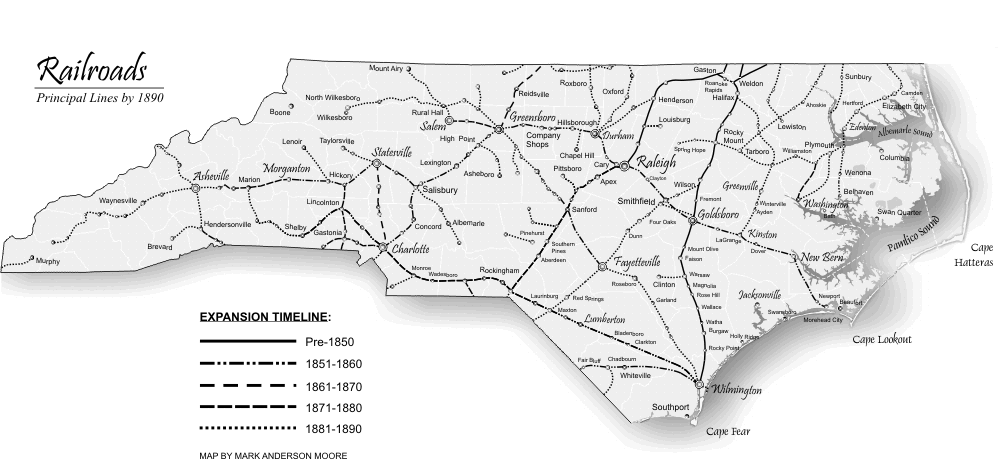
On October 25, 1836, construction began on the Wilmington and Raleigh
Railroad to connect the port city of Wilmington with the state capital of Raleigh. In 1849 the North Carolina Railroad was
created by act of the legislature to extend that railroad west to Greensboro, High Point, and Charlotte. During the Civil
War the Wilmington-to-Raleigh stretch of the railroad would be vital to the Confederate war effort; supplies shipped into
Wilmington would be moved by rail through Raleigh to the Confederate capital of Richmond, Virginia.
| Vital North Carolina Civil War Railroads Map |
|
| Map of North Carolina Railroads during the Civil War |
| General W.H.C. Whiting |
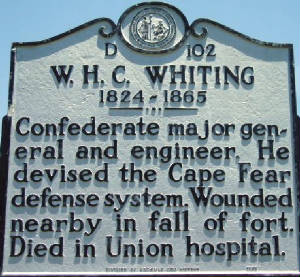
|
| (March 22, 1824 - March 10, 1865) |
| Fort Fisher, North Carolina |
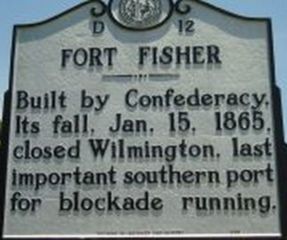
|
| (Historical Marker) |
"All
day and all night on the 13th and 14th of January 1865," says Confederate Colonel Lamb, "the Union fleet kept up a ceaseless
and terrific bombardment....It was impossible to repair damage at night. No meals could be prepared for the exhausted garrison;
the dead could not be buried without new casualties. Fully 200 had been killed during these two days, and only three or four
of the land guns remained serviceable."
No effort of any importance seems to have been made
by the commanding general, Braxton Bragg, to assist the doomed fort.
“Then the massive land forces approached nearer and
nearer by pits and shelter, and Colonel Lamb, and all their officers and men fight for the important fort; frequently did
they signal for the aid they sorely needed.”
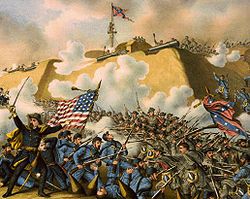
General Whiting, a most gallant and noble soldier, and Colonel
Lamb, a determined veteran and warrior, were both severely wounded. On the 15th of January, after exhausting every energy,
Fort Fisher was surrendered. The Federal loss is stated at 1,445. The Confederate garrison lost about 500. Few more gallant
defenses against such odds are recorded. General Whiting died shortly after in a Northern prison.
| Salisbury Prisoner of War Camp |
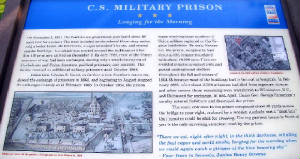
|
| Salisbury, NC, Prison |
The state's Salisbury National Cemetery has mass graves containing 11,700 unknown Union soldiers buried in 18
trenches (each 240 feet long) marked by head and foot stones. The graves are adjacent to the former site of a Confederate
prison. Next, the nation experienced the Reconstruction Era.
North Carolina's Sacrifice at Gettysburg: "Those Tar Heels!"
| North Carolina Monument |
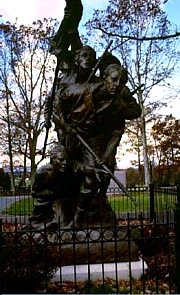
|
| (Gettysburg NMP) |
At Gettysburg, this North
Carolina Monument is dedicated to the Tar Heel State's forty-two regiments and batteries which fought at the Battle of Gettysburg. The North Carolina legislature appointed a special commission of veterans
to visit the battlefield park in 1913 and return with a design proposal for a state monument to be place there, but the advent
of World War I put the state's plans on hold. It was not until 1927 when the plan was rekindled by the North Carolina Chapter
of the United Daughters of the Confederacy and Governor Angus McLean. The state appropriated $50,000 to purchase the site,
contract with an artist for the design and manufacture, and provide landscape features as an appropriate setting.
Dedicated on July 3, 1929, the North Carolina Monument is the work of world
re-known sculptor Gutzon Borglum (1867-1941) whose most famous work is the four presidents on Mount Rushmore. The monument
represents a group of North Carolina soldiers in "Pickett's Charge". Fifteen North Carolina infantry regiments, all of which had suffered
heavily during the first day's battle, participated in the attack. The monument is accompanied by dogwoods, which is the state
tree, and a stone monolith that lists the North Carolina commands present at
Gettysburg.
Two regiments were especially hard hit at that pivotal battle
known as Gettysburg -- the 24th Michigan Infantry (70% casualties) and the 26th North Carolina Infantry (80% casualties). Twenty one year-old
Colonel Henry Burgwyn Jr., commanding the 26th North Carolina, was mortally wounded while leading one
of the last charges against the 24th Michigan. Shot, through both lungs, Burgwyn fell with the Twenty-sixth Regimental Flag
wrapped around him. He was the youngest commanding colonel in Lee's army.
North Carolina
and the Price in Blood
| Battle of Fort Fisher, North Carolina |
|
| Kurz and Allison, 1890 |
North Carolina furnished roughly one-sixth of the entire Confederate
Army. And at the surrender at Appomattox, one-half of the muskets stacked were from North Carolina. The last charge of the Army of Northern Virginia under Lee was made by North Carolina troops. The Old North State sent at least 125,000 soldiers into combat and more than 40,000
perished, which is roughly 1-in-3 or one-third of North Carolina’s
army. North Carolina deaths
were more than twice the percentage sustained by the soldiers from any other state.
Roughly 6.5% of the total killed during the Civil War hailed from the Tar
Heel State. North
Carolina soldiers totaled a staggering 22% of all Confederate combat deaths (killed-in-action and mortally wounded).
The South lost 25%
of its military aged men, however, about 32% of North Carolina's combatants died. For every soldier killed in
combat two died from disease. 12.5% of the entire Confederate Army that died from disease hailed
from the Old North State.
While 33 generals were North Carolinians, 9 were killed in
battle (or roughly 27% of the state's generals were killed-in-action). An estimated three-and-a-half million men (3,500,000) fought
in the Civil War and 620,000 perished -- which is greater than the combined casualties from all previous U.S. wars combined. Diseases and Napoleonic Linear Tactics, consequently, were the contributing factors for the high casualties during the war.
Recommended Reading: The
Civil War in North Carolina. Description: Numerous battles and skirmishes were fought in North Carolina
during the Civil War, and the campaigns and battles themselves were crucial in the grand strategy of the conflict and involved
some of the most famous generals of the war. Continued below...
John Barrett presents the complete story of military engagements across the state, including the classical
pitched battle of Bentonville--involving Generals Johnston and Sherman--the siege of Fort Fisher,
the amphibious campaigns on the coast, and cavalry sweeps such as General Stoneman's Raid. Also available in hardcover:
The Civil War in North Carolina . .
A Tribute to the Faithful of North Carolina
| Private Henry Lawson Wyatt Memorial |
|
| First Confederate Soldier Killed in the Civil War |
| Brig. Gen. James Johnston Pettigrew |
|
| (Killed shortly after Gettysburg) |
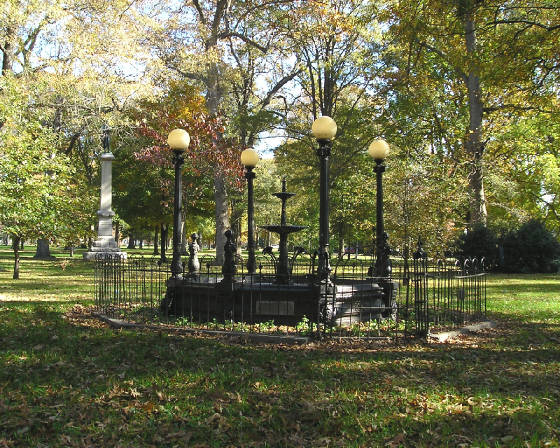
North Carolina native Henry Lawson Wyatt
was the first Confederate soldier killed in the Civil War. Wyatt was killed at the Battle of Big Bethel in Virginia on June
10, 1861. The Henry Lawson Wyatt Memorial Fountain (above), honoring Henry L. Wyatt, is located in Private Lawson's hometown
of Tarboro, North Carolina.
"How splendid and great they were in their modest,
patient, earnest love of country! How strong they were in their cause, and pure they were in their faith, and constant they
were in their principles! How they bore suffering and hardship, and how their lives were ready at the call of duty! What magnificent
courage, what unsullied patriotism! Suffering they bore, sacrifice they endured, duty they performed, death they faced and
met, all for the love of the dear old home land; all this for the glory and honor of North Carolina! As they were faithful
unto thee, guard thou their names and fame, grand old mother of us all! If thy sons in the coming times shall learn the lesson
of heroism their lives inspired and their deeds declared, then not one drop of blood was shed in vain." Judge Roulhac, Forty-ninth
North Carolina Regiment
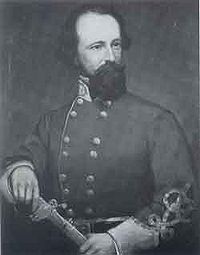
"North Carolina native James Johnston Pettigrew
(July 4, 1828 – July 17, 1863) was an author, scholar, lawyer, linguist, diplomat, and a Confederate general in the
American Civil War. He was a major leader in the disastrous Pickett's Charge and was killed a few days after the Battle of
Gettysburg during the Confederate retreat to Virginia."
| Brig. Gen. J. J. Pettigrew |
|
| (Historical Marker) |
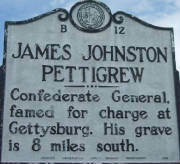
"North Carolina native James Johnston Pettigrew
(July 4, 1828 – July 17, 1863) was an author, scholar, lawyer, linguist, diplomat, and a Confederate general in the
American Civil War. He was a major leader in the disastrous Pickett's Charge and was killed a few days after the Battle of
Gettysburg during the Confederate retreat to Virginia."
"I
apprehend that if all living Union soldiers were summoned to the witness stand, every one of them would testify that it was
the preservation of the American Union and not the destruction of Southern slavery that induced him to volunteer at the call
of his Country. As for the South, it is enough to say that perhaps eighty percent of her armies were neither slave-holders, nor had the remotest interest in the institution...both sides fought and suffered
for liberty as bequeathed by the Fathers--the one for liberty in the union of the States, the other for liberty in the independence
of the States."
Reminiscences
of the Civil War, by John B. Gordon, Maj. Gen. CSA. General
Gordon was shot 5 times during the Battle of Antietam but did not die until January 9, 1904. Although Gen. John Gordon was a Confederate,
President Theodore Roosevelt stated that "A more gallant, generous, and fearless
gentleman and soldier has not been seen by our Country."
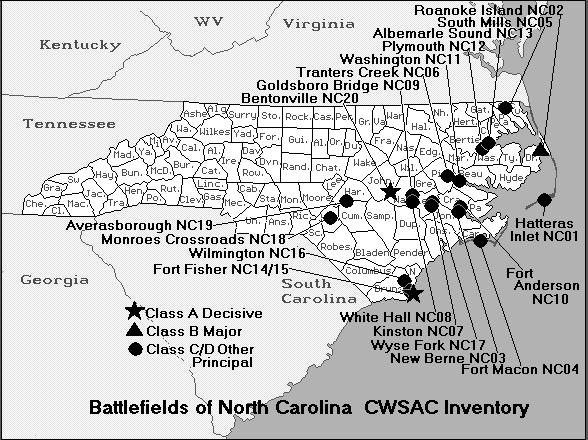
| Map of North Carolina Civil War Battles |
|
| (Includes the State's Major Battles and Battlefields) |
North Carolina American Civil War Fatalities*
Killed in Action
| STATE |
Killed
(Officers) |
Killed
(Enlisted) |
Total |
Died of Wounds
(Officers) |
Died of Wounds
(Enlisted) |
Total |
|
|
|
|
|
|
|
| North Carolina |
677 |
13,845 |
14,522 |
330 |
4,821 |
5,151 |
Died from Diseases
| STATE |
Officers |
Enlisted |
Total |
|
|
|
|
| North Carolina |
541 |
20,061 |
20,602 |
Death Total
| KIA |
Wounds |
Diseases |
Total |
| 14,522 |
5151 |
20,602 |
40,275 |
|
|
|
|
*Fatalities Equal Dead; Casualty Does Not Equal Dead
Casualties include three categories: 1) dead (aka fatalities, killed-in-action and mortally
wounded); 2) wounded; and 3) missing or captured. In general terms, casualties of Civil War battles included 20% dead and
80% wounded. Of the soldiers who were wounded, about one out of seven died from his wounds. Over 2/3 of the estimated 620,000
men who gave their lives in the Civil War died from disease, not from battle.
North Carolina War Deaths (aka Fatality Total)
The following numbers show deaths (excluding wounded and missing)
Source: North Carolina Museum of History
| Civil War |
992,622 (1860) |
40,275 (CSA) |
| World War I |
2,206,287 (1910) |
2,375 |
| World War II |
3,571,623 (1940) |
7,000 |
| Korean War |
4,061,929 (1950) |
876 |
| Vietnam War |
4,556,155 (1960) |
1,572 |
American Civil War Fatalities and Casualties
When one totals the Americans that died in the Revolutionary War, War of 1812, Mexican American War,
Spanish American War, World War One, World War Two, Korean War and Vietnam War, it is comparable to the total American Civil War casualties.
Union Fatality Estimates:
Battle Deaths: 110,070
Disease, etc.: 250,152
Total Deaths: 360,222
Confederate Estimated
Losses (Fatalities):
Battle Deaths: 94,000
Disease, etc.: 164,000
Total Deaths: 258,000
(Sources listed at bottom of page.)
Recommended Reading: Silk Flags and Cold
Steel: The Piedmont (The Civil War in North Carolina. Description: "Silk Flags and Cold Steel" is a fascinating
account of the effects of the American Civil War in North Carolina's Piedmont Region. Trotter's accounts of the relationship
between wartime N.C. Governor Zebulon Vance and the Confederate Government in Richmond, and a masterful re-telling of the
Battles of Averasboro and Bentonville (Sherman's March through the Carolinas), makes this a book worthy of any Civil War buffs
library.
Recommended Reading: The Flags of Civil War North
Carolina. Description: Compiled and written by educator and Civil War expert Glenn
Dedmondt, The Flags Of Civil War North Carolina is a very straightforward reference presenting
photographs, color illustrations, descriptions and history of the titular flags that flew over North
Carolina when it seceded from the Union. Each page or two-page spread features
the different flags of the various North Carolina regiments.
A meticulously detailed resource offering very specific information for history and civil war buffs, The Flags Of Civil War
North Carolina is a welcome contribution to the growing library of Civil War Studies and could well serve as a template for
similar volumes for the other Confederate as well as Union states. Great photos and illustrations! Continued below.
Flags stir powerful emotions,
and few objects evoke such a sense of duty and love for the homeland. In April 1861, the first flag of a new republic flew
over North
Carolina. The state had just seceded from the union, and its citizens would soon have to fight for
their homes, their families, and their way of life. Each flag is meticulously detailed and scaled to perfection. The Flags
of Civil War North Carolina is the history of this short-lived
republic (which later joined the Confederacy), told through the banners that flew over its government, cavalry, and navy.
From the hand-painted flag of the Guilford Greys to the flag of the Buncombe Riflemen--made from the dresses
of the ladies of Asheville--this collection is an exceptional
tribute to the valiant men who bore these banners and to their ill-fated crusade for independence. About
the Author: Glenn Dedmondt, a lifelong resident of the Carolinas and member of the Sons of Confederate Veterans, shares
his passion for the past as a teacher of South Carolina
history. Dedmondt has also been published in Confederate Veteran magazine.
Recommended Reading: Remembering
North Carolina's Confederates (NC) (Images of America). Description: The American Civil War was scarcely over when a group of
ladies met in Raleigh and began to plan commemoration for the honored Confederate dead of North Carolina. In 1867, they held their first memorial service. Two
years later in Fayetteville, the first monument to the state's
fallen Confederate soldiers was erected. Over the next 14 decades, countless monuments were commissioned in cemeteries and
courthouse squares across the state. Continued below…
Following Reconstruction, the
veterans themselves began to gather in their local communities, and state and national reunions were held. For many of the
Confederate veterans, honor for their previous service continued long after their deaths: accounts of their sacrifice were
often chiseled on their grave markers. The numerous images within this book, photographs of veterans and reunions, monuments,
and tombstones are but a sampling of the many ways that the old Confederate soldiers are commemorated across the Old
North State. About the Author:
Historian and photographer Michael C. Hardy is truly one-of-a-kind; he has dedicated and sacrificed his life preserving North Carolina’s Civil War history and heritage. With unmatched
zeal and enthusiasm, Michael travels thousands of miles annually, while crisscrossing North Carolina,
teaching, educating, speaking, listening, researching, and reading every conceivable aspect of the Civil War as it relates
to the Old North State. Michael C. Hardy is the author of numerous books and articles about North Carolina's role during the Civil War. This is his second book
for Arcadia Publishing. A popular speaker for history associations, preservation groups, and museums, he lives with his wife,
Elizabeth, and son, Nathaniel, in the mountains of Western North Carolina.
Recommended Reading: The Civil War in North Carolina: Soldiers' and Civilians'
Letters and Diaries, 1861-1865. Volume 2: The Mountains (Civil War in North Carolina)
(Hardcover). Description: As with The Civil War in North Carolina: Soldiers' and Civilians' Letters
and Diaries, 1861-1865. Vol. 1: The Piedmont, this work presents letters and diary entries (and a few other documents) that tell the experiences of soldiers and
civilians from the mountain counties of North Carolina during
the Civil War. The counties included are Alleghany, Ashe, Buncombe, Burke, Caldwell, Cherokee,
Clay, Haywood, Henderson, Jackson, McDowell, Macon,
Madison, Mitchell, Polk, Rutherford, Surry, Transylvania,
Watauga, Wilkes, and Yancey. The book is arranged chronologically, 1861 through 1865. Before each letter or diary entry, background
information is provided about the writer. Continued below...
The Civil War
in North Carolina: Soldiers'
and Civilians' Letters and Diaries, 1861-1865 (Volume 2): The Mountains, is the soldier's story. It is an A-to-Z compilation
of what the "rank and file soldier" experienced during the American Civil War. The Western
North Carolina soldiers express their hearts to their loved ones and friends, thus allowing the reader
the most intimate and personal view of the war. From triumph to tragedy, the "soldiers' letters" express what few authors
or writers can achieve--realism. According to cartographic and demographic studies, Southern
Appalachia comprised a unique indigenous people, and by isolating these rare letters it allows the
reader the most detailed insight to their experiences. The soldier experienced various traumatic stressors in the conflict:
such as witnessing death or dismemberment, handling dead bodies, traumatic loss of comrades, realizing imminent death, killing
others and being helpless to prevent others' deaths. Plain, raw and to the point: The
reader will witness the most detailed insight to the so-called American Civil War. Intimate and personal: diseases, privation,
wounds, loneliness, exhaustion, heartache, and death are all explored. This book includes a lot of information about: Western North Carolina Civil
War History (North Carolina mountain troops), soldiers' photos (some
tintype photographs too), and rare pictures. For example, on page 143, there is a photo of Gov. Zeb Vance's brother,
Robert, at Fort Delaware Prisoner of War Camp; he had been captured by Pennsylvania cavalry in East Tennessee. You may see
a rare photo or letter of an ancestor. The maps, which reflect the region, have keys which place each regiment
to each respective western county (where the troops were raised). The soldiers - collectively - also
present a detailed North Carolina Civil War History. By reading the letters, you will easily form a timeline that is
filled with first-hand facts. To be very candid, it is not only filled with primary accounts of the war, but it is one
of the best books to read about the war...Creates an indispensable historical timeline of the life, times, and events of
the brave men from the Old North State.
Recommended Reading: Ironclads and Columbiads: The Coast
(The Civil War in North Carolina) (456 pages). Description: Ironclads and Columbiads
covers some of the most important battles and campaigns in the state. In January 1862, Union forces began in earnest to occupy
crucial points on the North Carolina coast. Within six months,
Union army and naval forces effectively controlled coastal North Carolina from the Virginia line south to present-day Morehead
City. Continued below...
Union setbacks
in Virginia, however, led to the withdrawal of many federal soldiers from North Carolina, leaving only enough Union troops
to hold a few coastal strongholds—the vital ports and railroad junctions. The South during the Civil War, moreover,
hotly contested the North’s ability to maintain its grip on these key coastal strongholds.
Recommended Reading: Bushwhackers, The Civil War in North Carolina: The Mountains (338 pages). Description: Trotter's book (which could have been titled "Murder, Mayhem, and Mountain Madness") is
an epic backdrop for the most horrific murdering, plundering and pillaging of the mountain communities of western North Carolina
during the state’s darkest hour—the American Civil War. Commonly referred to as Southern Appalachia, the North Carolina and East Tennessee mountains witnessed divided loyalties
in its bushwhackers and guerrilla units. These so-called “bushwhackers” even used the conflict to settle old feuds
and scores, which, in some cases, continued well after the war ended. Continued below...
Some bushwhackers
were highly organized ‘fighting guerrilla units’ while others were a motley group of deserters and outliers,
and, since most of them were residents of the region, they were familiar with the terrain and made for a “very formidable
foe.” In this work, Trotter does a great job on covering the many facets of the bushwhackers, including their: battles,
skirmishes, raids, activities, motives, the outcome, and even the aftermath. This book is also a great source for tracing
ancestors during the Civil War; a must have for the family researcher of Southern Appalachia.
Recommended Reading: Touring the Carolina's
Civil War Sites (Touring the Backroads Series). Description: Touring the Carolina's Civil War Sites helps travelers find the Carolinas' famous
Civil War battlefields, forts, and memorials, as well as the lesser skirmish sites, homes, and towns that also played a significant
role in the war. The book's 19 tours, which cover the 'entire Carolinas,' combine riveting history with clear, concise directions
and maps, creating a book that is as fascinating to the armchair reader as it is to the person interested in heritage travel.
Below are some examples from this outstanding book:
1. Fort Fisher - the largest sea fort in the war that protected the
vital town of Wilmington N.C., and the blockade runners so important for supplying Lee's Army of Northern Virginia.
2. Charleston
- where the whole shootin' match started.
3. Bentonville - the last large scale battle of the war.
4. Outer Banks - early Union victories here were vital to capturing many parts of Eastern North Carolina from which the
Union could launch several offensives.
5. Sherman's
March - the destruction of certain towns in both Carolinas (particularly South Carolina)
further weakened the South's will to continue the struggle.
I also enjoyed reading about the locations of various gravesites
of Confederate generals and their Civil War service. Indeed, if not for this book, this native North Carolinian and long-time
Civil War buff may never have learned of, and visited, the locations of some of the lesser-known sites other than those mentioned
above.
Johnson's writing style is smooth--without being overly simplistic--and contains several anecdotes (some humorous
ones too) of the interesting events which took place during the Civil War years. Highly recommended!
North Carolina American Civil War
Sources: Walter Clark, Histories of the Several Regiments
and Battalions from North Carolina in the Great War 1861-1865; D. H. Hill, Confederate Military History Of North Carolina: North Carolina In The Civil War, 1861-1865; Weymouth
T. Jordan and Louis H. Manarin, North Carolina Troops, 1861-1865; North Carolina Office of Archives and History; North Carolina Department of Cultural Resources; North Carolina Museum
of History; State Library of North Carolina; North Carolina Department of Agriculture; University Library, The University
of North Carolina at Chapel Hill; National Park Service: American Civil War; National Park Service: Soldiers and Sailors System;
Library of Congress; Official Records of the Union and Confederate
Armies; National Archives and Records Administration; United States Department of Veterans Affairs; Library
of Congress: American War Casualty Lists and Statistics; William F. Fox, Regimental Losses in the American Civil War; Gettysburg
National Military Park.
|


